
BUYERS
OUR FOCUS
OUR NEIGHBORHOODS
Contact
- 34 South St Jamaica Plain, MA 02130
- 6176764082
- info@focusre.com
The Real Cost of "Good Schools" in Greater Boston

Boston-area parents face a version of this question every year: stretch to buy in a town like Newton for the public schools, or buy a more affordable home in Boston proper and cover private tuition at a school like BB&N or Beaver Country Day instead?
The instinct is that tuition is money you never get back, while a pricier home builds equity. But that framing skips the real costs on both sides — a bigger mortgage, higher property taxes in the "good" district, and what that extra cash could have earned if it had gone into the market instead of a down payment.
The Numbers: Newton vs. Boston
Using the same modeling approach Realtor.com applied to a Chicago-area comparison, here's how it plays out locally for a family with one child starting kindergarten, over 13 years (K–12):
- Family A buys a median-priced home in Newton (~$1.95M), known for top-tier public schools like Newton North and Newton South.
- Family B buys a more affordable Boston home (~$900K) and sends their child to a private day school in the BB&N/Beaver Country Day tier, where tuition runs roughly $50,000–$70,000 a year depending on grade.
Assuming a 20% down payment, a 30-year mortgage around 6.75%, 3% annual home appreciation, 3% annual growth in property taxes and tuition, and a 5% return on money the Boston family invests instead of spending on a pricier home:
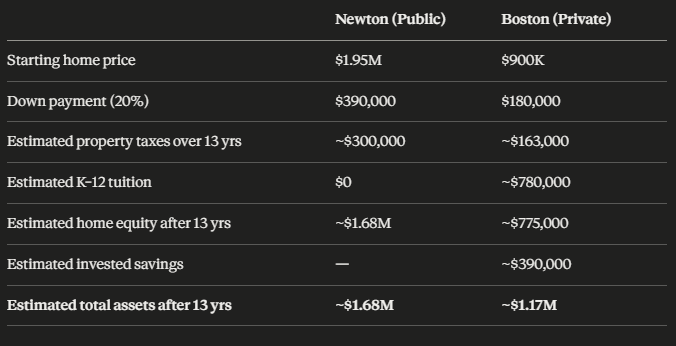
Figures are illustrative estimates based on current median home prices, published FY2025 residential tax rates, and typical private day school tuition for Newton and Boston — not a precise forecast for any individual family.
In this model, the Newton family ends up roughly $500,000 ahead after 13 years — a wider gap than in the national example, largely because Boston-area independent school tuition (often $60K–$70K/year at schools like BB&N) runs well above the national average for private K–12 education.
Why the Gap Is Bigger Here Than in Other Metros
Two things make the Boston-area math especially lopsided:
- Elite private day school tuition in Boston is among the highest in the country. Schools like BB&N charge close to $70,000 a year at the upper grades — nearly double what a similarly regarded school might cost in many other U.S. metros.
- Newton's property tax rate is actually lower than Boston's, at $9.80 per $1,000 of assessed value versus Boston's $11.58. Newton residents pay more in taxes only because home values there are so much higher — the rate itself isn't the premium.
Add a Second Child, and the Math Gets Brutal
Property tax bills don't really change based on family size. Private tuition does — dramatically. Two kids at a BB&N-level school could mean $1.4 million or more in combined tuition over 13 years, even before accounting for financial aid or sibling discounts (many families do qualify for aid — BB&N reports roughly a quarter of families receive it).
Meanwhile, the Newton family's mortgage and tax bill stay essentially the same whether they have one child or three. That's the core reason the math tips harder toward the pricier public-school suburb as family size grows.
Tax Breaks Worth Knowing About
- For 2026, itemizing taxpayers can deduct up to $40,400 in state and local taxes, which takes some sting out of a hefty Massachusetts property tax bill (though it phases down for higher earners).
- Starting in 2026, families can pull up to $20,000 per beneficiary per year tax-free from a 529 plan for K–12 tuition — a real help for Boston-area private school families, though not enough on its own to close a $70K/year gap.
Neither break is guaranteed to look the same over a 13-year stretch, so it's risky to bank on today's rules for the whole ride.
The Boston Home Buys You Flexibility
The one thing the spreadsheet doesn't fully capture: optionality. If a Boston family's finances change, tuition can be reduced through aid or dropped by switching to Boston Public Schools. A $1.95M mortgage in Newton is much harder to walk back without selling the house.
The Bottom Line
Even with sky-high private tuition, buying the cheaper home in Boston isn't a bad move on its own — it's a real, viable path, especially for families with more than one child or less certainty about staying in the district long-term. But for a single child who'll attend a top-tier Boston-area independent school for 13 years, this model suggests the pricier Newton home is likely to come out ahead financially — and by a wider margin than in cheaper private-school markets elsewhere in the country.
As always: the better choice isn't necessarily the one that wins on a spreadsheet — it's the one your family can comfortably afford today, and would still choose even after the kids graduate.
Methodology and framework adapted from Realtor.com, "Steep Property Taxes vs. Private Tuition: Which Option Costs Homebuyers More?" Newton and Boston home price, property tax, and tuition figures sourced from local market data as of mid-2026.